
When selecting a spray booth ventilation system, it is easy to assume that a more powerful fan will deliver better performance. After all, higher fan power sounds like a simple way to improve airflow, remove paint overspray, and create a cleaner working environment.
However, a more powerful spray booth fan is not always a better choice.
In industrial painting applications, the real objective is not to maximize fan power. It is to achieve the correct airflow, maintain stable air movement, capture overspray effectively, and meet the booth’s operational and safety requirements—all while controlling energy consumption and maintenance costs.
Choosing an oversized or incorrectly matched fan can lead to unnecessary electricity costs, excessive air velocity, unstable airflow distribution, and reduced overall system efficiency.
For spray booth manufacturers, industrial coating contractors, automotive equipment distributors, and factory procurement managers, understanding how fan performance relates to the entire ventilation system is essential to making the right investment.
In this guide, we explain what really matters when selecting a spray booth fan and how to determine the right ventilation solution for your application.
1. Why Fan Power Alone Does Not Determine Spray Booth Performance
The first thing to understand is that fan motor power, airflow, and static pressure are three different parameters.
They are related, but they are not interchangeable.
Motor Power: How Much Energy the Fan Uses
Fan motor power, typically expressed in kilowatts (kW) or horsepower (HP), indicates the motor’s power rating or energy input, depending on the specification.
A higher-rated motor may support greater airflow or higher pressure, but it does not automatically guarantee better ventilation.
Two fans with the same motor power can deliver different airflow rates and pressure performance because of differences in impeller design, rotational speed, fan efficiency, and operating conditions.
Airflow: How Much Air the Fan Moves
Airflow is usually measured in cubic meters per hour (m³/h) or cubic feet per minute (CFM).
It determines how much air the ventilation system can move through the spray booth under specified operating conditions.
Insufficient airflow may result in inadequate contaminant removal, poor overspray capture, or failure to maintain the intended airflow pattern.
However, excessive airflow can increase heating, cooling, and electrical costs without delivering a proportional improvement in coating quality.
Static Pressure: How Much Resistance the Fan Can Overcome
A spray booth ventilation system contains multiple sources of resistance, including:
- Intake filters and pre-filters
- Exhaust filters and paint arrestors
- Ductwork, bends, and transitions
- Dampers, grilles, and air distribution components
- Other components installed in the ventilation path
The fan must deliver the required airflow while overcoming the total system resistance.
A fan that performs well under low-resistance conditions may fail to deliver the required airflow when connected to a system with restrictive filters or long ductwork.
The key principle: Select a fan based on its performance at the required airflow and system static pressure, rather than choosing the fan with the largest motor.
2. What Happens When You Choose an Oversized Spray Booth Fan?
Installing a larger fan may seem like a way to add extra capacity for future needs. However, if the fan is not properly matched to the ventilation system, several problems can arise.
2.1 Higher Energy Consumption
A more powerful motor can increase operating costs, especially in facilities where spray booths run for multiple shifts or operate continuously throughout the working day.
The actual energy consumption depends on the fan’s operating point, motor efficiency, control method, and system resistance—not simply its rated power.
For example, consider two illustrative ventilation solutions:
- System A uses a 5.5 kW motor.
- System B uses an 11 kW motor.
If both systems can satisfy the same required airflow and pressure, the larger motor does not automatically provide a practical advantage.
Actual savings depend on measured or specified operating input power, operating hours, and electricity tariffs. A larger motor may be justified when additional capacity is genuinely required, but unnecessary oversizing can increase total ownership costs.
For B2B buyers, evaluating energy consumption over the equipment’s service life is often more meaningful than comparing motor ratings alone.
2.2 Unstable Airflow and Uneven Ventilation
A spray booth is a controlled airflow environment, not simply an enclosed space that needs to be ventilated as quickly as possible.
Depending on the booth design, an oversized or poorly controlled fan may create excessive local air velocities, turbulence, or uneven airflow distribution.
These conditions can affect how overspray travels toward the exhaust filters and may contribute to inconsistent coating conditions.
For applications that require a controlled down-draft, semi-downdraft, cross-draft, or other specific airflow pattern, the complete system must be designed to distribute air appropriately.
A larger exhaust fan cannot compensate for poorly designed air inlets, incorrectly positioned filters, or inadequate air distribution.
2.3 Increased Heating and Cooling Costs
In temperature-controlled spray booths, ventilation performance directly affects the energy needed to condition incoming air.
In cold weather, excessive exhaust airflow can increase heating demand. In hot or humid climates, additional ventilation may increase cooling and dehumidification loads.
This is particularly important for industrial finishing lines and automotive refinishing facilities that require stable temperature and humidity conditions.
The correct solution is to match ventilation capacity to process requirements and coordinate supply air, exhaust air, and environmental controls.
2.4 More Noise and Additional Equipment Stress
Fan noise depends on several factors, including rotational speed, impeller design, installation quality, duct configuration, and operating point.
Selecting a fan that is unnecessarily large or operating it outside its intended performance range can create avoidable noise and vibration issues.
Poor system matching can also contribute to unstable operation and increased maintenance requirements.
The goal should be reliable operation within the fan manufacturer’s recommended operating range—not maximum output at all times.
3. When Is a More Powerful Spray Booth Fan Actually Necessary?
Although oversizing can be wasteful, choosing a fan that is too small is equally problematic.
Higher-capacity equipment may be necessary when the application requires greater airflow, higher static pressure, or additional operational flexibility.
Large Spray Booths and Industrial Painting Lines
A large industrial spray booth generally requires more ventilation capacity than a small automotive refinishing booth, although the exact requirement depends on the process, booth geometry, and applicable standards.
Facilities painting large components, machinery, commercial vehicles, or industrial structures may need higher airflow capacity to achieve the required ventilation conditions.
High-Resistance Exhaust Systems
Systems with long duct runs, multiple bends, restrictive filters, or additional treatment equipment may require a fan capable of delivering the target airflow at a higher static pressure.
In these situations, simply installing a fan with a larger motor is not enough. The fan curve must be checked against the expected system resistance.
Future Production Expansion
Manufacturers planning to increase production may need additional ventilation capacity.
However, buying an oversized fan in advance is not always the most economical strategy.
Depending on the application, a properly selected variable-frequency drive (VFD), a fan with an appropriate operating range, or a modular ventilation design may offer better flexibility.
Any provision for future capacity should be evaluated against the actual process requirements, control strategy, motor limitations, and applicable safety requirements.
The best fan is the one that meets the required operating conditions reliably, with appropriate capacity for the intended application.
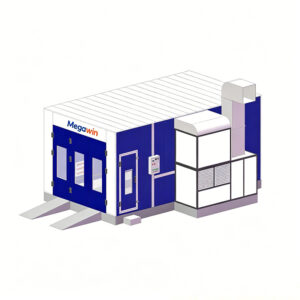
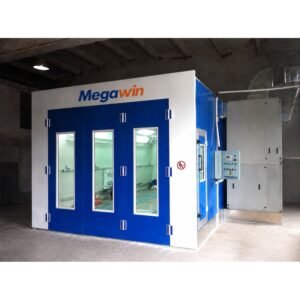
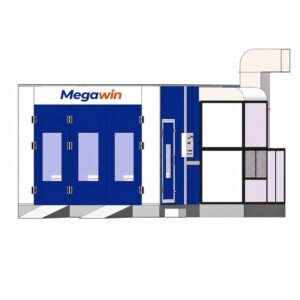
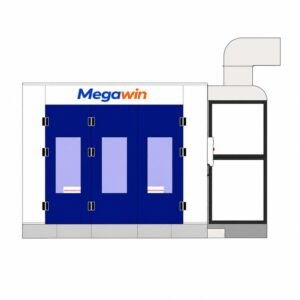
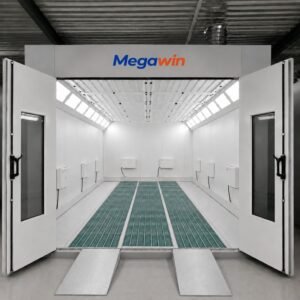
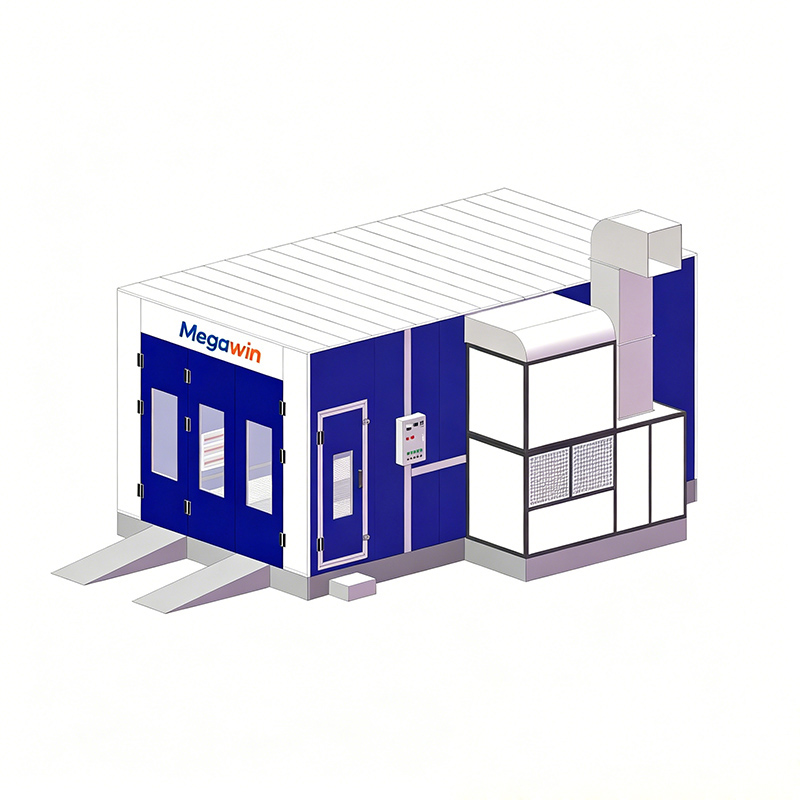
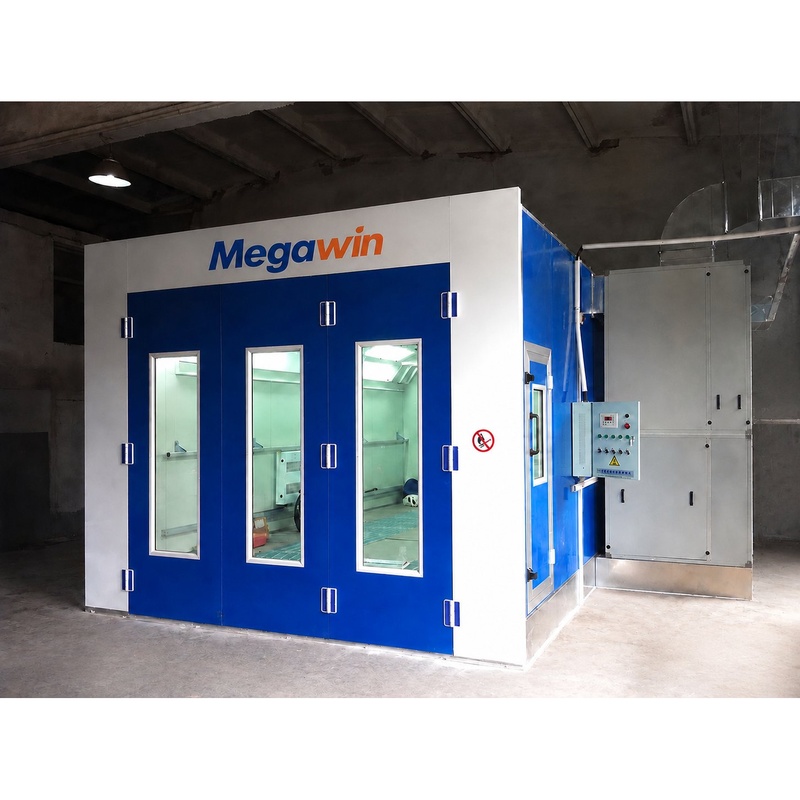
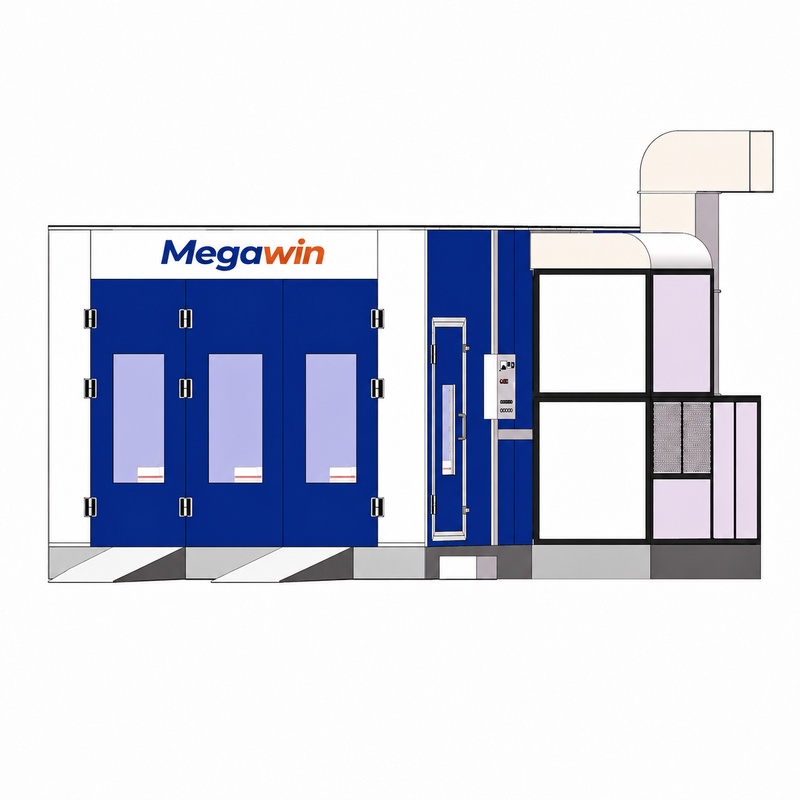
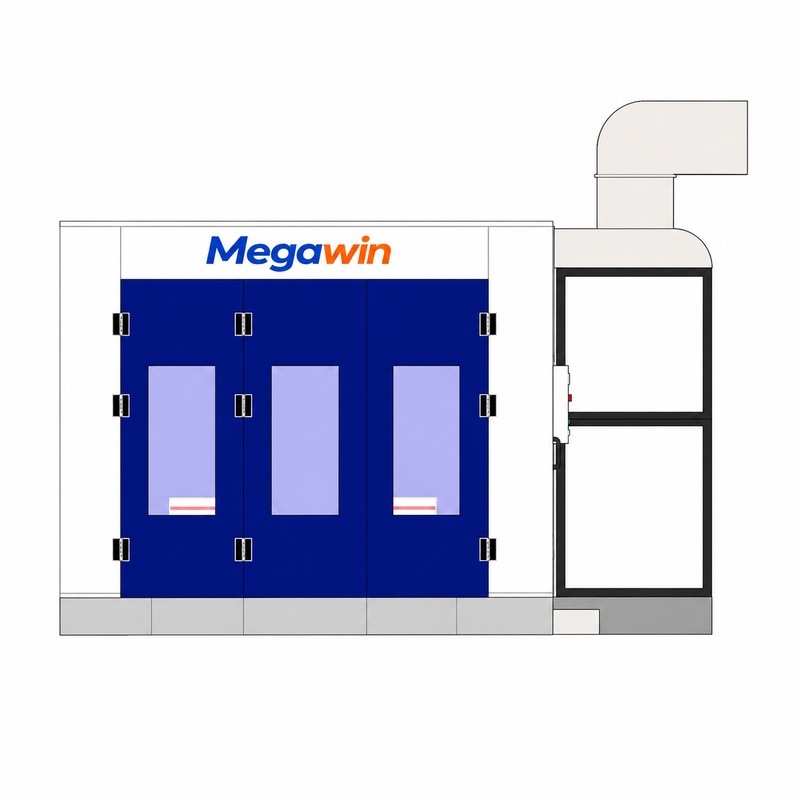
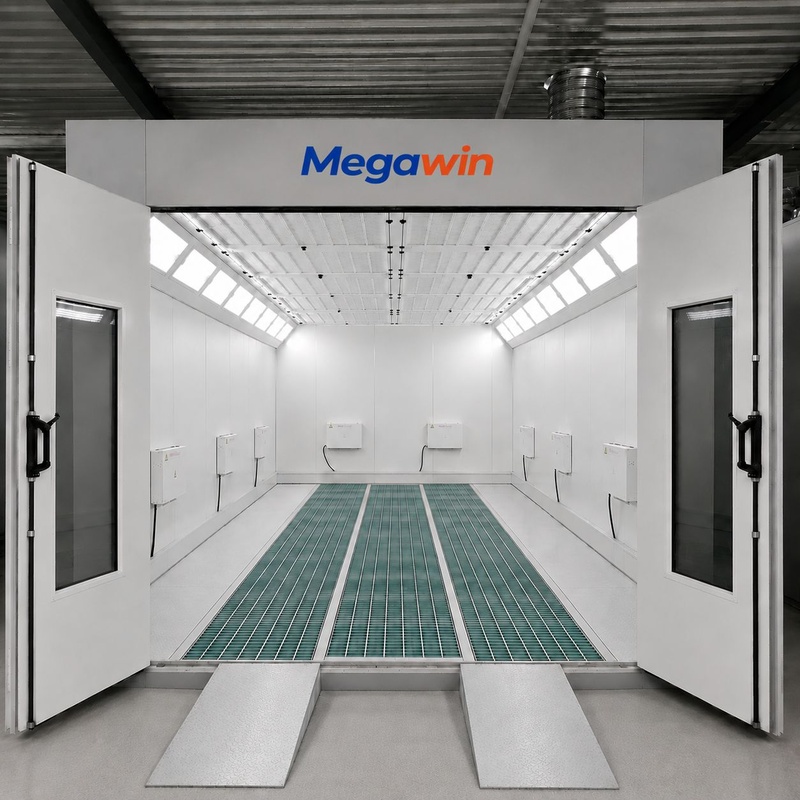
MGW-E70 Electric-Heat Car Spray Booth
MGW-E70 electric-heat spray booth is used for standard car spraying and baking,by side exhaust
4. How to Calculate the Airflow Requirements of a Spray Booth
Fan selection should begin with the booth and process, not with a motor catalog.
One preliminary method is to estimate airflow from the booth’s effective cross-sectional area and the required average air velocity.
For a simplified, uniform airflow arrangement:
Airflow = Effective Cross-Sectional Area × Average Air Velocity
In metric units:
Q = A × V × 3,600
Where:
- Q = airflow in m³/h
- A = effective cross-sectional area in m²
- V = average air velocity in m/s
- 3,600 = conversion factor from seconds to hours
Example: A Simplified Spray Booth Airflow Estimate
Assume a booth has an effective airflow cross-section of 4 m² and a preliminary design target of 0.3 m/s.
The estimated airflow is:
Q = 4 × 0.3 × 3,600 = 4,320 m³/h
This calculation gives a preliminary airflow estimate only. The example is not a universal design recommendation or a statement of the required velocity for every spray booth.
Actual requirements depend on the booth configuration, painting process, coating materials, operator location, contaminant generation, filter arrangement, and applicable regulations.
A qualified ventilation designer should confirm the required airflow and its distribution before finalizing equipment selection.
Why Airflow Calculation Is Only the First Step
A correct airflow estimate does not automatically identify the correct fan.
The system designer must also evaluate:
- Required static pressure: The total resistance of filters, ductwork, dampers, and other components at the design airflow.
- Filter loading: The increase in resistance as filters accumulate overspray and contaminants.
- Air distribution: Whether the booth can maintain the intended airflow pattern throughout the working area.
- Operating conditions: Whether the booth runs continuously, intermittently, or under varying production loads.
- Safety and compliance: Whether the design satisfies the relevant ventilation, fire protection, electrical, and hazardous-area requirements.
A fan should therefore be selected using its performance curve at the required operating point, with suitable allowance for expected system conditions.
5. Five Factors to Check Before Buying a Spray Booth Fan
For equipment buyers, comparing fan specifications systematically can prevent costly mistakes.
Factor 1: Fan Performance Curve
Request the manufacturer’s fan performance curve.
It should show the relationship between airflow and static pressure under the stated test conditions. The selected operating point should provide the required airflow at the expected system resistance.
Avoid making purchasing decisions based solely on maximum airflow or maximum pressure figures, because these values may represent different operating conditions.
Factor 2: Filter Resistance and Maintenance Conditions
Filters play a major role in determining ventilation system resistance.
Ask the supplier to clarify whether the proposed fan selection accounts for clean-filter and loaded-filter conditions.
The system should maintain the required ventilation performance as filters become loaded, within the limits defined by the design and filter manufacturer.
A filter replacement or maintenance strategy should be part of the overall ventilation plan.
Factor 3: Supply and Exhaust Air Balance
The exhaust fan does not operate independently of the supply air system.
An imbalance between supply and exhaust can affect booth pressure, air distribution, door operation, and overall ventilation stability.
For systems that require controlled booth pressure or conditioned make-up air, both sides of the ventilation system should be evaluated together.
Factor 4: Motor Efficiency and Speed Control
Motor efficiency, fan efficiency, and control strategy all influence energy consumption.
A properly selected VFD can help regulate airflow when the application allows variable-speed operation.
However, speed control must be compatible with the fan, motor, control system, and required ventilation conditions. It must not compromise minimum ventilation, safe operation, or applicable hazardous-area requirements.
Factor 5: Safety, Certification, and Application Suitability
Spray booths may handle flammable vapors, combustible coatings, or hazardous airborne contaminants.
Fan construction, motor placement, electrical equipment, bonding, and installation details must be appropriate for the materials being sprayed and the applicable regulations.
Where hazardous locations are present, equipment selection must follow the relevant classification and certification requirements.
Do not assume that an ordinary industrial fan is suitable for every spray booth application. Confirm the required specifications with a qualified designer and the equipment manufacturer.
6. How Does the Right Fan Improve Total Cost of Ownership?
For B2B buyers, the purchase price is only one part of the decision.
A properly matched ventilation system can help reduce unnecessary energy consumption, support stable production conditions, and simplify maintenance planning.
The total cost of ownership should consider:
- Initial fan and ventilation system cost
- Electricity consumption over the expected service life
- Heating, cooling, and make-up air costs
- Filter replacement and maintenance
- Downtime associated with ventilation problems
- Installation, commissioning, and future expansion requirements
For example, a lower-cost fan that cannot maintain the required airflow under real operating conditions may become an expensive choice after installation.
Likewise, a larger fan may be worth the additional investment when the application genuinely requires higher capacity or when a suitable control strategy improves operating flexibility.
The right comparison is not simply between a small fan and a large fan. It is between complete ventilation solutions that meet the same performance, safety, and production requirements.
For equipment distributors and project contractors, this approach also helps create more accurate quotations and reduces the risk of specification mismatches after delivery.
7. Why Work with a Spray Booth Manufacturer Instead of Choosing a Fan by Power Rating?
Selecting a fan is easier when the supplier understands the entire spray booth system.
A qualified manufacturer or ventilation engineering partner should be able to evaluate the relationship between booth dimensions, airflow requirements, exhaust filtration, duct resistance, and the intended painting process.
Before confirming a solution, the supplier should be able to discuss:
- Recommended airflow and static pressure
- Suitable fan type and motor rating
- Supply and exhaust air configuration
- Filter resistance and maintenance requirements
- Energy efficiency and possible speed control
- Installation conditions and applicable safety requirements
- Customization options for different booth sizes and production needs
For distributors and OEM customers, these details are especially important when sourcing equipment for multiple projects or developing a standardized product range.
A technically sound selection process can help reduce installation issues, improve quotation accuracy, and support long-term customer satisfaction.
8. Get the Right Spray Booth Fan for Your Project
Are you planning a new spray booth, upgrading an existing ventilation system, or sourcing spray booth equipment for your customers?
Choosing the right fan does not have to mean choosing the most powerful one.
The best solution depends on your booth dimensions, target airflow, system resistance, coating process, and local compliance requirements.
Our team can help evaluate your project requirements and identify a suitable spray booth ventilation solution based on your application.
To help us assess your project, please provide the following information:
- Booth dimensions: Length × width × height
- Booth type: Cross-draft, semi-downdraft, down-draft, or other configuration
- Application: Automotive refinishing, industrial coating, furniture finishing, machinery painting, or another process
- Coating materials: Relevant paint types and any known hazardous-area requirements
- Operating conditions: Expected production hours and required environmental controls
- Project requirements: Target airflow, available installation space, local voltage, and applicable standards, if known
If you are unsure about the required airflow or fan specifications, that is not a problem. Start with your booth dimensions and application details, and a qualified engineer can help identify the information needed for proper selection.
Contact our team today to discuss your spray booth project, request a ventilation solution, or obtain a quotation for your equipment requirements.
Let’s find the right balance between ventilation performance, energy efficiency, operational reliability, and total cost of ownership.
Frequently Asked Questions
Is a higher CFM fan always better for a spray booth?
No. Higher CFM is useful only when it matches the booth’s ventilation requirements and system resistance. Excessive airflow can increase energy costs and disrupt the intended airflow pattern. Fan selection should be based on the required operating point and applicable safety requirements.
How do I know what size exhaust fan my spray booth needs?
Start by determining the required airflow from the booth configuration, process, and applicable design criteria. Then calculate or estimate system static pressure, including filters and ductwork, and select a fan using its performance curve. Final sizing should be verified by a qualified ventilation professional.
What is more important: fan CFM or static pressure?
Both matter. CFM indicates the volume of air delivered, while static pressure indicates the fan’s ability to overcome system resistance. The fan must achieve the required airflow at the actual operating pressure.
Can I use a larger fan to compensate for dirty filters?
Not as a substitute for proper maintenance. Filter loading increases system resistance and can reduce airflow. The correct response is to monitor filter condition, follow the manufacturer’s replacement criteria, and ensure the ventilation system is designed for its expected operating conditions. A larger fan alone does not resolve every filtration or airflow problem.
Does a spray booth need a dedicated exhaust fan?
That depends on the booth design, process, and applicable requirements. The ventilation system must be engineered to provide the necessary contaminant control and safe exhaust handling. The suitability of a dedicated fan or a shared system should be assessed by a qualified designer.
Can a VFD improve spray booth fan efficiency?
A VFD can reduce energy consumption in suitable applications by adjusting fan speed to match actual demand. However, savings depend on the system curve, operating schedule, control strategy, and required minimum airflow. It must be properly engineered for the fan, motor, and safety requirements.
What information should I send to a supplier for a spray booth fan quotation?
Provide the booth dimensions, booth type, coating application, required airflow if known, filter configuration, ductwork information, operating conditions, power supply, and project location. If some information is unavailable, a preliminary assessment can begin with the dimensions and application.
Need help selecting a spray booth ?
Contact our team with your project details to discuss fan sizing, ventilation system configuration, customization options, and a solution suited to your operating requirements.